
If your horse has been lame – on and off or just not quite right for longer than feels normal – you’ve probably already tried something. Rest. A course of treatment. A change in work. Maybe more than one of each.
If it’s helped, even a little, it’s tempting to keep going on the same path. If it hasn’t helped, it’s tempting to try something else before escalating to further investigation.
Both of those instincts are completely understandable. But there’s a question worth sitting with: what actually happens if the underlying cause never gets properly identified?
The lameness treat & repeat loop
There’s a pattern that’s very common in equine lameness and it looks something like this:
Horse shows signs of lameness > vet visit > treatment > improvement > return to work > signs return > repeat.
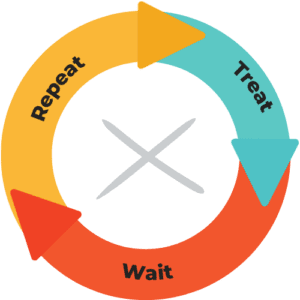
Sometimes this loop runs for months. Sometimes years. Each cycle feels like progress while it’s happening; the horse gets better, you get back to work, things feel normal. Until they don’t.
The problem isn’t the treatment. It’s that treatment without diagnosis is, at best, educated guesswork. It might address the symptom. It’s much less likely to address the cause. And if the cause isn’t addressed, the cycle continues – often with the horse’s condition gradually worsening in the background, even when the surface signs improve.
Rest, joint medication and controlled exercise all have an important role in managing lameness. But they manage it. They don’t always resolve it. For some causes of lameness, repeated management without diagnosis allows the underlying problem to become more established, harder to treat and more likely to affect your horse’s long-term soundness.
What you might be missing
Lameness has many causes and the right treatment depends entirely on which one you’re dealing with.. Many causes of persistent or recurrent lameness cannot be accurately localized on clinical examination alone.
Imaging is often the only way to see what’s actually happening. Different types of imaging show different things:
Radiography (X-ray) – is excellent for bony changes but less good for soft tissue structures – tendons, ligaments, joint capsules, cartilage.
Ultrasound – shows soft tissue well , but has significant limitations in the foot and in structures that are deep or poorly accessible due to bony structures obscuring the ultrasound waves. It can also be difficult to determine the full extent, activity, or chronicity of a lesion based on ultrasound findings alone.
CT (Computed Tomography) – creates detailed 3D images of your your horse’s bones and joints, helping to spot issues that may not be visible on standard X-rays. This can help your vet uncover the underlying cause of lameness when the answer isn’t obvious, giving you greater clarity on the problem and helping guide the most appropriate treatment plan.
MRI – particularly standing MRI in the horse, shows both hard and soft tissue in detail that no other modality can match. It’s the reason it’s considered the gold standard for diagnosis of many lameness conditions, particularly useful for investigating foot pain. More recently technological advances have increased it’s utility in a growing range of conditions higher up the limb. It can also be difficult to determine the full extent, activity, or chronicity of a lesion based on ultrasound findings alone.
“If your horse has been through multiple treatment cycles without a clear resolution, there’s a reasonable chance that what’s causing the problem hasn’t actually been seen yet.”
Carina Northern, BVSc MRCVS, Vet Surgeon
The real cost of waiting
It’s worth being honest about cost, because it’s usually a significant part of the thinking around further investigation. Advanced imaging, MRI included, is not cheap. That’s a fair and important consideration and it’s not something to brush past. But don’t be too quick to dismiss MRI on cost alone. Depending on your insurer, advanced imaging such as MRI may well be included in your policy so a quick call to check your cover could pay dividends.
But the cost of not getting a lameness diagnosis is also real and it tends to be less visible until it adds up. Think about what repeated treatment cycles cost over six months or a year: vet visits, medication, time off work, competition entries missed, the cost of keeping a horse that isn’t sound. That’s before you factor in the cost of a problem becoming more complex, because some lameness conditions when left undiagnosed go on to progress. Soft tissue injuries that are managed but not identified can worsen with each return to work. Early joint changes that might have been treated conservatively at diagnosis can become more established over time.

A diagnosis that costs more upfront can – and often does – cost considerably less overall. It points treatment in the right direction, avoids months of trial and error and gives you and your vet a clear plan rather than an educated guess.
It also gives you something less easy to quantify: certainty. Knowing what you’re dealing with changes everything about how you manage it, how you talk to your vet and how you think about your horse’s future.
When to push for more answers
You know your horse. If something feels wrong – if the same problem keeps coming back, if your horse isn’t responding the way you’d expect, if your gut says this isn’t resolved – that’s worth listening to.
Some specific signals that further investigation may be warranted:
- Lameness that recurs within weeks or months of treatment
- Improvement that plateaus and doesn’t progress to full soundness
- A horse that’s sound in the paddock but not under saddle, or only struggles on certain surfaces or circles
- Performance changes without an obvious explanation
- Multiple episodes of lameness in the same limb, even if the presentations seem different
None of these is a diagnosis. But all of them are good reasons to have a conversation with your vet about whether there’s more to find.
What that conversation looks like
Asking for further investigation doesn’t mean doubting your vet’s judgement, it means working with them to make sure you have the full picture. Most vets will welcome the conversation, particularly if you can describe clearly what you’ve observed, what treatment has been tried, and what’s changed (or not changed).
Talk Lameness has a lameness quiz that can help you organise your observations before that conversation.
Our guide to 5 things to discuss with your vet that walks you through how to prepare.
If your vet recommends referral for imaging, that’s a good sign – it means the diagnostic process is moving forward, not stalling. If you want to understand what standing MRI actually involves.
The Talk Lameness webinar on the standing MRI process walks you through it step by step.
Want to understand what further investigation involves? Read: Lameness diagnosis – why it’s important for horse and owner.
In short…
So, what are the risks of not getting a lameness diagnosis? Treating without diagnosing can work, but it can also mean months of time, money and effort spent managing a problem rather than solving it. Meantime, the underlying cause quietly becomes harder to treat. If your horse keeps coming back to the same place, it might be time to find out why.
Not sure what you’re seeing? Then take the quiz: