
why early answers can cost far less than you think
If your vet has suggested an MRI for your horse, there’s a good chance your first reaction was to the price. It’s a natural one. An MRI feels like a big outlay and when surgery is also on the table it can be tempting to think: why not skip the scan and go straight to the operation?
It’s an understandable instinct, but it’s worth pausing on. Because the real question is not what a scan costs today. It’s more about what the cost of not scanning could cost you over the next year: in money, in time and in the frustration of watching your horse fail to come right.
The hidden cost of not knowing
Lameness is one of the most challenging problems in the horse world precisely because the outward signs rarely tell the whole story. A horse that is sore in the foot, not quite tracking up, or simply not performing as it used to, can have any one of a number of underlying problems – and they don’t all respond to the same treatment.
Without a clear diagnosis, the usual path is to try something and see. A course of treatment, a period of rest, then back into work. Sometimes it helps. Often the improvement is partial or it doesn’t last and the horse ends up back at the clinic. Each round of guesswork carries its own cost: the repeat visits, the treatments that were never quite targeted, the weeks and months that slip by.
Added together, that cycle frequently ends up more expensive and more drawn out than one early, diagnostic scan would have been. Breaking that loop is what an MRI is for. It replaces “let’s try this and see” with a precise picture of what’s actually wrong.
When straight to surgery is not the shortcut it seems
This matters most when surgery is being considered. Take a common scenario: a horse with chronic pain in the proximal suspensory region – the top of the ligament running down the back of the leg. There’s a well-established surgical option for this and in the right horse it works well, with many horses returning to their previous level of work post surgery.
But, there’s a crucial phrase in that sentence: “in the right horse.” Horses that look identical on the yard, and even block to the same region, can have very different things going on inside the leg. One might have a problem confined to the ligament. Another might have significant changes in the bone itself. The surgery that suits the first horse may do little for the second, and you wouldn’t know which horse you had without looking inside.
That’s the situation an MRI is designed to prevent. Committing to surgery based on an incomplete picture, only to discover twelve months and a full rehabilitation later that coexisting pathology meant surgery was never the right decision, is the most expensive outcome of all. Not just financially, but in the year of your horse’s life you cannot get back. (The clinical detail behind this – and why specialists increasingly scan before deciding on surgery – is set out in a piece written for vets, if you would like to share it with yours.)
Seen in that light, the upfront cost of an equine MRI scan starts to look less like an expense and more like insurance against a far bigger one.
What an MRI actually buys you
The value of standing MRI isn’t really the images. It’s the decisions those images allow you and your vet to make with confidence.
- A diagnosis you can act on: MRI shows both bone and soft tissue in a single examination and it can reveal active problems – early ligament damage, inflammation, the so called bone oedema (or bruise) – long before other methods would pick them up. That means treatment can be aimed at the actual problem from the start.
- The right call on surgery: a scan can confirm that an operation is the sensible next step or it can steer you away from one that was never going to help. Either way, you’re making the decision with the full picture.
- A faster, more targeted return to work: when you know exactly what you are treating, treatment can be tailored to the location and pathology – from the therapy injected to the rehabilitation plan – making recovery more targeted and predictable. For a competition horse, that difference can be an entire season.
- Peace of mind: there’s real value in simply knowing. Living with an undiagnosed lameness – the not knowing, the false starts, the worry that you are doing the wrong thing – takes a quiet toll. A clear answer lifts a lot of that.
“The value of standing MRI isn’t really the images. It’s the decisions those images allow you and your vet to make with confidence.”
Humphrey Grimmett – Vet Surgeon
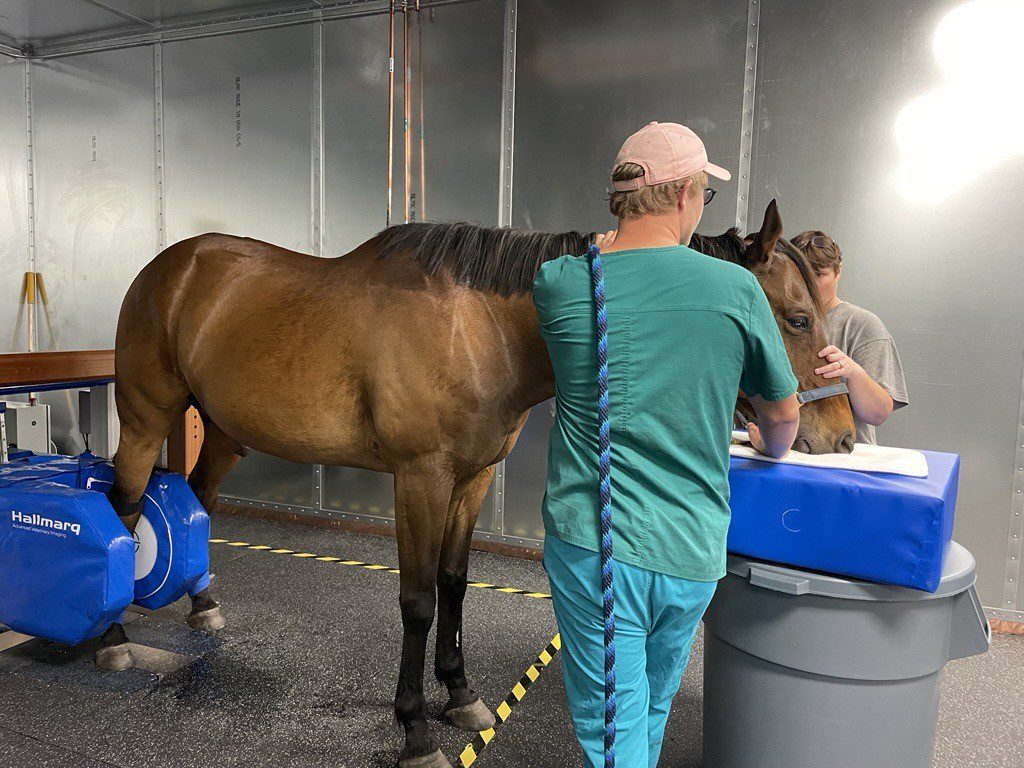
It’s worth saying, too, that the scan itself is a gentle procedure. Your horse stays standing and lightly sedated throughout, there’s no general anaesthetic and in most cases they are home the same day. Our Guide to Standing Equine MRI walks through exactly what to expect on the day.
Value you cannot put a price on
Some of what an MRI gives you does not show up on an invoice at all:
- The months of your horse’s working life that would otherwise be lost to trial and error.
- The comfort of a horse whose pain is being treated properly rather than managed around.
- The confidence of understanding what can be treated, what to expect from rehabilitation, and when a particular intervention may not be the right choice, or could even allow the underlying pathology to deteriorate.
For many owners, when you weigh the cost of a scan against the cost of a year spent going in circles, the sums look very different from how they seemed at first.
Talk it through with your vet
Every horse and every situation is different and the right path is always a conversation between you, your horse and the vet who knows them. If your horse has a lameness that’s proving hard to pin down or if any significant treatment decision is being weighed up, it’s well worth asking your vet whether an MRI would help you make that decision with more certainty.
You can read through the answers to common owner questions or browse real case studies to see how a definitive diagnosis changed the course of treatment for other horses. And remember:
“The cost of an MRI is easy to see. The cost of not having one is the one worth thinking about.”
Chrysanthi Pitaloui – Vet Surgeon, DVM, CertAVP
Further reading to put your mind at ease:
- Guide to Standing Equine MRI: everything you need to know
- Proximal suspensory disease: should you scan before surgery?
Or, watch the video: The standing equine MRI process, to learn just how safe, effective and affordable the gold standard modality can be when assessing your horse’s lameness.