
The five minutes before you tack up could be the most useful minutes in your horse’s week. Not because anything dramatic happens in them (it usually doesn’t), but because they’re the point at which you’re paying attention. Observing your horse without distraction, actually seeing them in front of you, rather than arriving, tacking up and getting on.
Problems can arise slowly over time. The changes that point to discomfort, tend to build gradually before they become obvious, in ways that are easy to miss when you’re on a schedule. A short, deliberate check before you ride gives you a comparison point. Done consistently, it also gives you a picture of what’s normal for your horse, which is exactly what allows you to notice when something isn’t.
This isn’t a clinical protocol. You’re not trying to diagnose anything. You’re just looking and what you’re looking for is change.
Step 1: approach and observe before you touch
Before you go into the stable or catch up in the field, pause and look at the horse from a short distance. This only takes about 30 seconds and it’s often where you spot the most useful things, because the horse hasn’t yet adjusted to your presence. Make a mental note (or write it down if you really unsure) of things like:
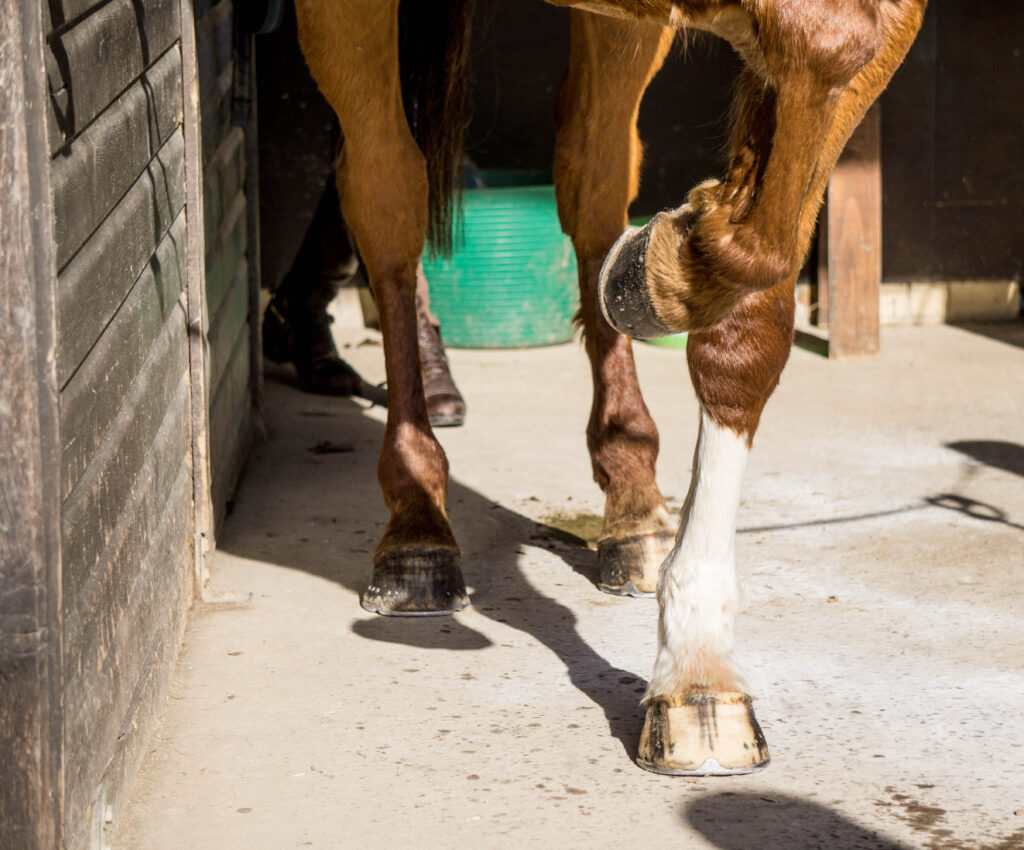
- How are they standing? A horse that’s resting a hindleg symmetrically (one leg resting, alternating normally) is relaxed and comfortable. A horse that is consistently resting the same leg, pointing a foreleg, or standing in a way that looks like they’re trying to take weight off something, is worth noting.
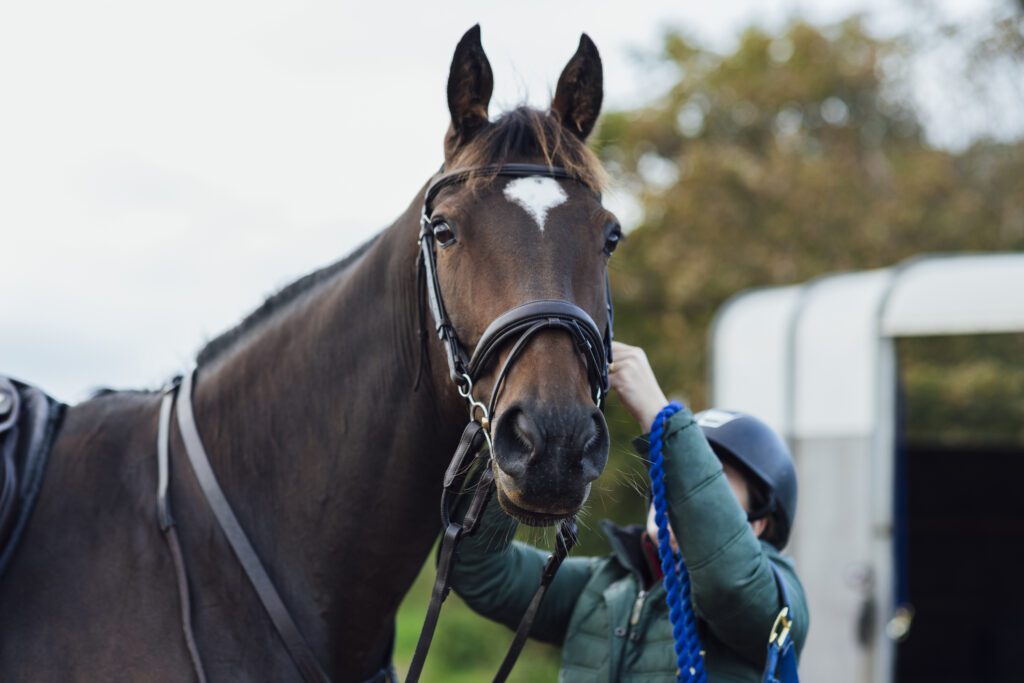
- Is there anything unusual about their posture or expression? Tension in the face, a lower head than usual, a tucked up look through the abdomen: these can all indicate that something is off, even when nothing dramatic is visible.
- Are they bright and interested? A horse that normally moves to greet you and doesn’t, or seems quieter or flatter than usual, may just be having a relaxed morning. But if it’s consistent, or combined with anything else on this list, it’s worth filing away.
Step 2: run your hands over the legs and feet
This is the most practical and useful part of the check, and only takes a couple of minutes once you know what you’re looking for.
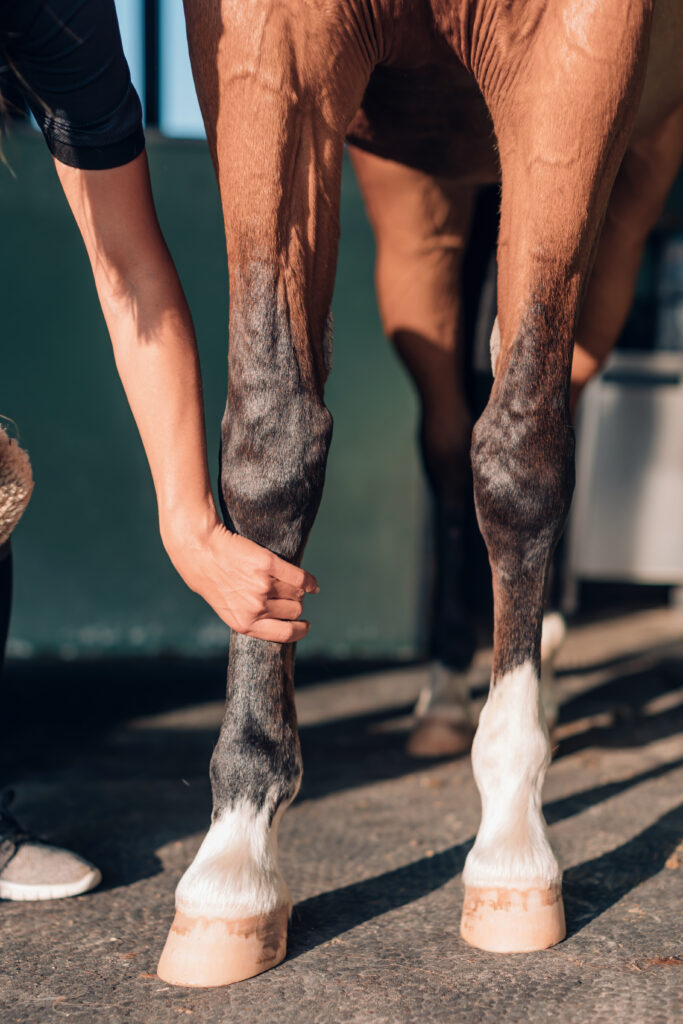
- Feel for heat: run your hands down each leg from the knee and hock downwards. Warmth in the digital pastern area – particularly on one foot compared to the others – can indicate increased blood flow, which often accompanies inflammation. This is not a diagnosis, it’s information. A foot that is consistently warmer than the others on multiple occasions is worth mentioning to your vet.
- Check the digital pulse: press your fingers lightly on either side of the pastern, just above the coronary band, to feel the pulse. It should be soft and barely detectable. A strong, bounding pulse, particularly in a foot that also feels warm, is one of the clearest signs that something may be wrong in that foot.
- Look for swelling: run your fingers along the tendons at the back of the lower leg. The tendons should feel firm and clearly defined, with no puffiness around them. Soft puffy swelling, especially after work, is worth monitoring. Any hard defined lump that wasn’t there before warrants a vet conversation.
- Pick out the feet: you were going to do this anyway! But this time pay particular attention to the sole and frog, check for any stones or debris lodged in awkward places, and notice whether anything looks different: a bruise, a small area of discolouration, a crack that’s growing.
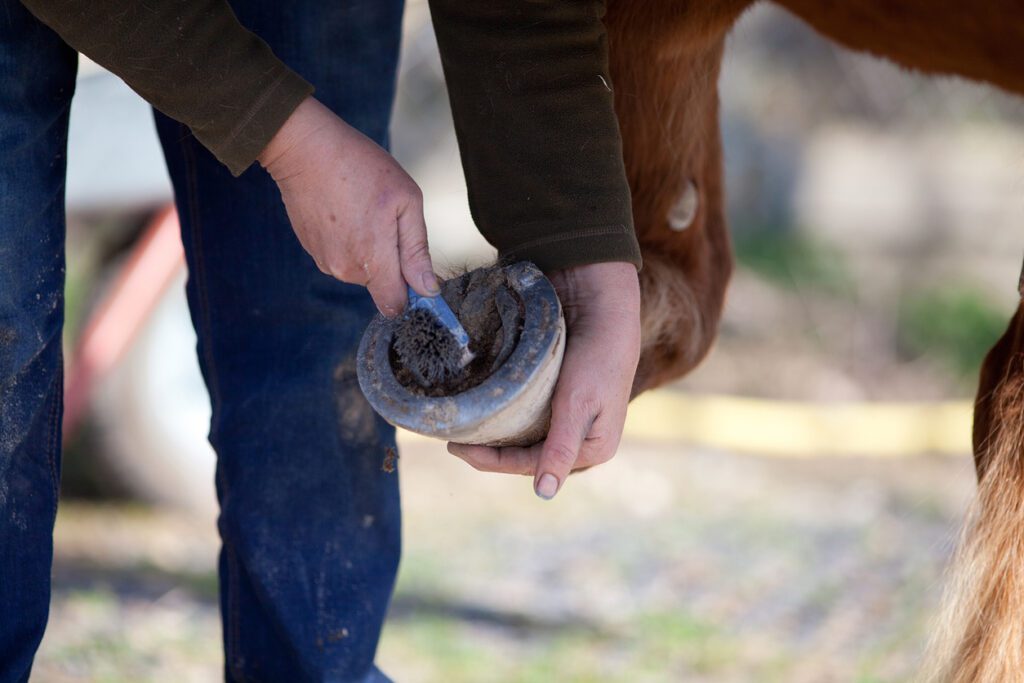
Take time to check for any unusual bruises, discolouration, or cracks when picking out your horse’s hooves.
Step 3: watch them move off
Before you tack up, lead your horse out and watch him walk for a few strides on a straight line. You’re not looking for anything dramatic, just the quality and rhythm of the movement.
- Is the walk even and relaxed? each stride should be roughly the same length left and right, with the head moving freely. A horse that is nodding their head as one front leg lands, or carrying one hip higher than the other. may be compensating for discomfort somewhere.
- Are they moving forward willingly? a horse who is reluctant to walk forwards, or that seems to hold back or brace against the lead rein may be stiff, may not want to leave the stable or may be uncomfortable. Context matters, but notice it.
- How do they take the first few steps? Some horses are genuinely stiff for the first few paces when coming out of a stable, others walk through it quickly. The question is whether they do walk through it and how long it takes. If a horse is still stepping awkwardly after 20–30 metres on a flat surface, that’s different from a couple of stiff paces out of the door.
Step 4: notice attitude and behaviour
Behaviour is part of the picture. It’s not a substitute for looking at movement, but it’s often the earliest thing an owner notices and it deserves to be taken seriously.
- Is your horse reacting differently to being tacked up than usual? a horse that pins its ears when the girth is done up, flinches away from the saddle, or turns to look at their flank more than usua,l may be telling you something about how their back or flanks are feeling.
- Are they more reactive or more dull than their normal? both can be relevant. A horse that is unusually tense or sharp may be uncomfortable. A horse that seems flat, slow to respond or just not quite themselves may also be.
- Does any of this behaviour feel new? the key question is always change. A horse that has always been a bit ear-pinny when girthed is different from a horse that has started doing it in the last few weeks.
What to do with what you’ve noticed
The check isn’t designed to give you answers, it’s designed to give you data. Most of the time, everything will look normal and you’ll tack up and get on. That’s fine. The value of doing it consistently is that on the days when something looks different, you have a basis for comparison.
If you notice something, write it down. “Some heat in left fore today, gone after a few minutes in walk” or “seemed reluctant to move off, fine once warmed up.” These small notes become genuinely useful in telling your horse’s story and, if a pattern develops, they’re exactly the kind of information a vet finds helpful when you call.
If you notice something repeatedly – particularly heat, swelling or movement changes that come back – don’t hesitate to make that call. You don’t need to wait until it’s obvious. Early attention means more options.
The Talk Lameness Quiz can help you put what you’re seeing into words. And if you’re unsure whether what you’ve noticed warrants a conversation with your vet, the answer is almost always: yes, it’s worth asking.
A note on building the habit
The hardest thing about the five-minute check is not the five minutes, it’s making it a habit rather than something you remember to do occasionally. The easiest way is to attach it to something you already do every time: picking out feet, putting on a headcollar or bringing the horse in from the field.
The goal is not to become anxious about your horse every time you go to ride. It’s to build a clear picture of what’s normal for them, so that change is visible; quickly and before it has become something harder to address.
Five minutes, every time. It’s worth it.
Some additional Talk Lameness resources may help you build a better picture of your horse’s lameness and feel more confident when approaching your vet. Take a look at these in particular:
If you’ve noticed changes in your horse’s movement: Why lameness isn’t always obvious.
Preparing to call your vet? 5 things to discuss before the visit.
Take the quiz: Is my horse lame?